From farm and field – down-to-earth
Down-to-earthness, attachment to one's homeland and family: the cornerstones of life.
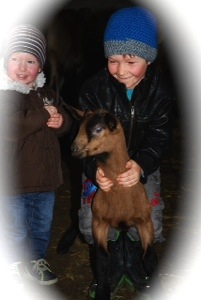
New arrivals in the goat shed
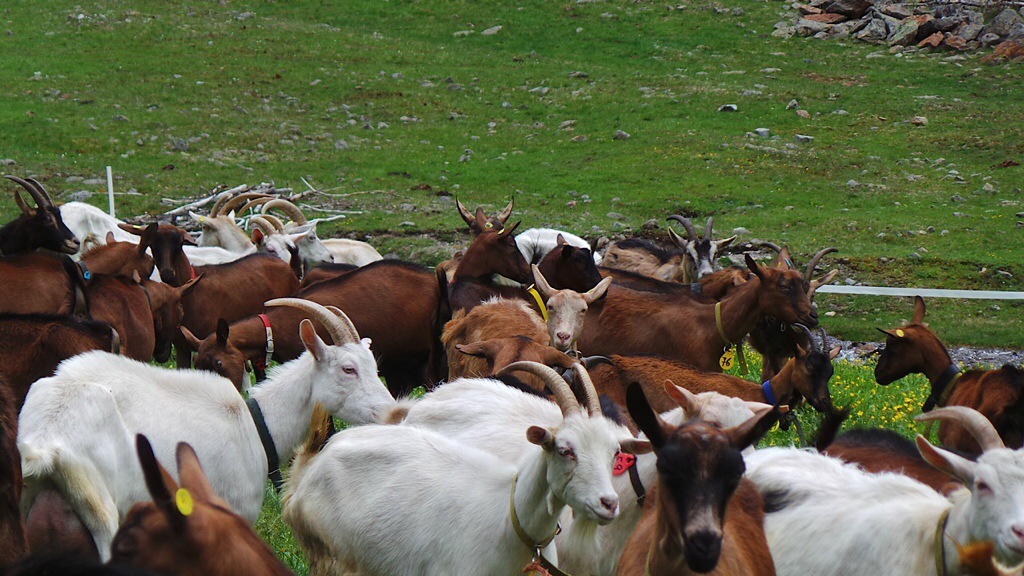
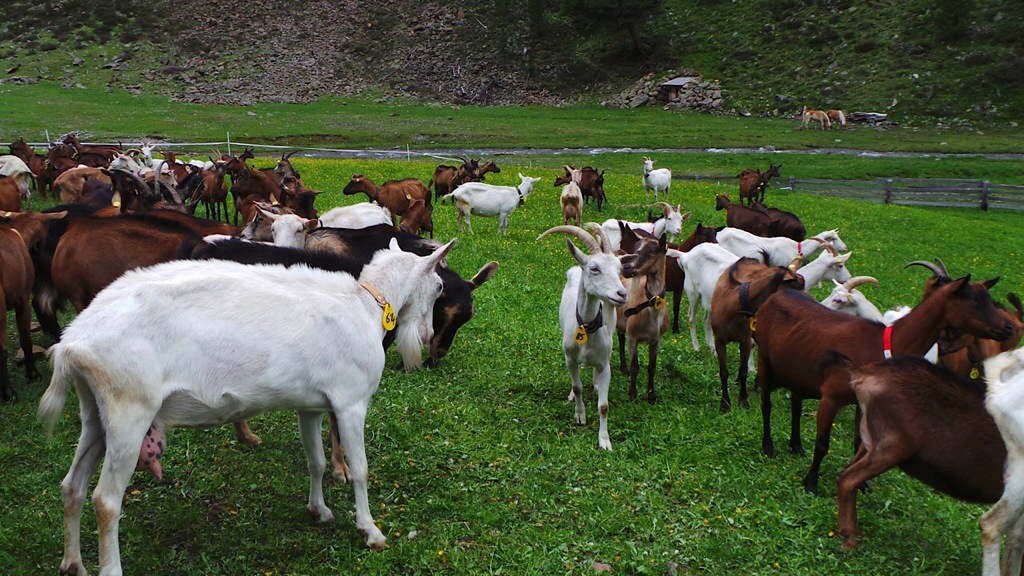
Like all domestic goats, the chamois-coloured goat is easy to tame. However, it tends to be rather reserved to shy by nature.
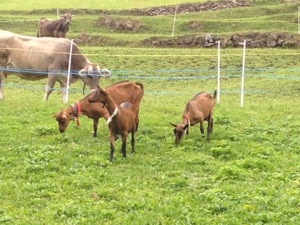
They have a very strong urge to move around: even when there is plenty of food available, chamois-coloured mountain goats never stay in one place for long when grazing in the open (except during rest periods when they ruminate) and cover long distances every day. Chamois-coloured goats are herd-oriented.
The average milk yield is 753.3 kg (with 3.4% fat and 3.0% protein) per lactation period with an average of 265.7 milking days, which corresponds to an average milk quantity of 2.84 kg per day. With intensive husbandry, values of well over 1000 kg per year are possible.
The special thing about the chamois-coloured mountain goat is that it can adapt its milk yield to the husbandry conditions. Pure high-performance dairy goat breeds invest a large part of the energy they consume in milk production, even under extensive husbandry conditions: under physically demanding husbandry conditions and climatic conditions typical of mountainous regions, this quickly takes its toll on their general health. This is not the case with the heat- and cold-tolerant chamois-coloured mountain goat, which can cope with harsh conditions and produce a milk yield that is significantly higher than that of other Swiss mountain goat breeds.
( Source: Wikipedia )
The chamois-coloured mountain goat is a typical mountain breed. However, it has proven itself not only in the mountains, but also in the lowlands. With a 20 per cent share of the goat population, it is the second most important goat breed in Switzerland.
There are two distinct breeds:
the mostly hornless Oberhasli-Brienzer type, which is mainly found in the Brienz region, the Gruyère region and the rest of western Switzerland, and the horned type from the cantons of Graubünden and Uri.
The chamois-coloured mountain goat is very robust and, with an average milk yield of 750 kilograms, is considered a good dairy goat. The goat has a smooth coat, but tolerates cold and heat quite well for short periods.
The height at the withers is approximately 85 cm for bucks and approximately 75 cm for does. Bucks weigh at least 75 kg and does weigh at least 55 kg. The skin is fine and the hair is short and smooth. Bucks reach sexual maturity at approximately 6 months and does at approximately 8 months. The chamois-coloured mountain goat gives birth to one or two kids after a gestation period of approximately 5 months.
The chamois-coloured goat has horns or is hornless. The coat is fawn to chestnut brown with black markings on the head and legs extending to the knee joint. Milk is light brown to black. The belly is dark with a fine eel stripe from the head to the base of the tail.
Average milk yield is 700 kg and above, with a fat content of 3.4% and a protein content of 2.9%. The lactation period is approximately 254 days.
The dorsal stripe is missing or wider than the pelvic bone. The head is black.
The animal has white spots larger than a five-franc coin.
Black flank, chest, body structure not conforming to the breed standard, boots missing.
Spiky hair or grey/white hair.
Bucks are judged more strictly than goats in all respects, except for black flanks and chest. Here, the tolerance for bucks is greater than for goats.